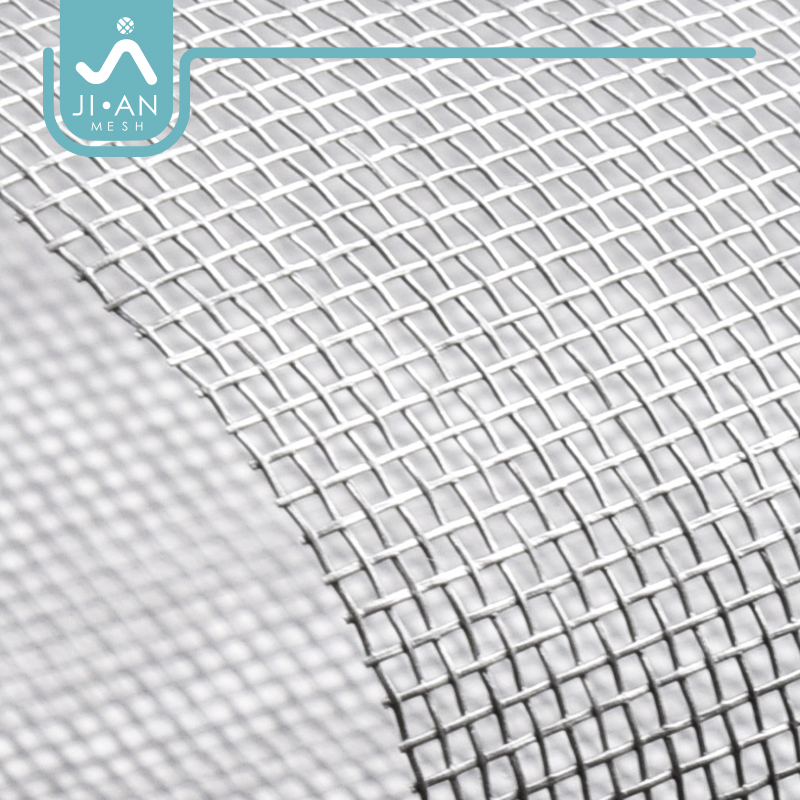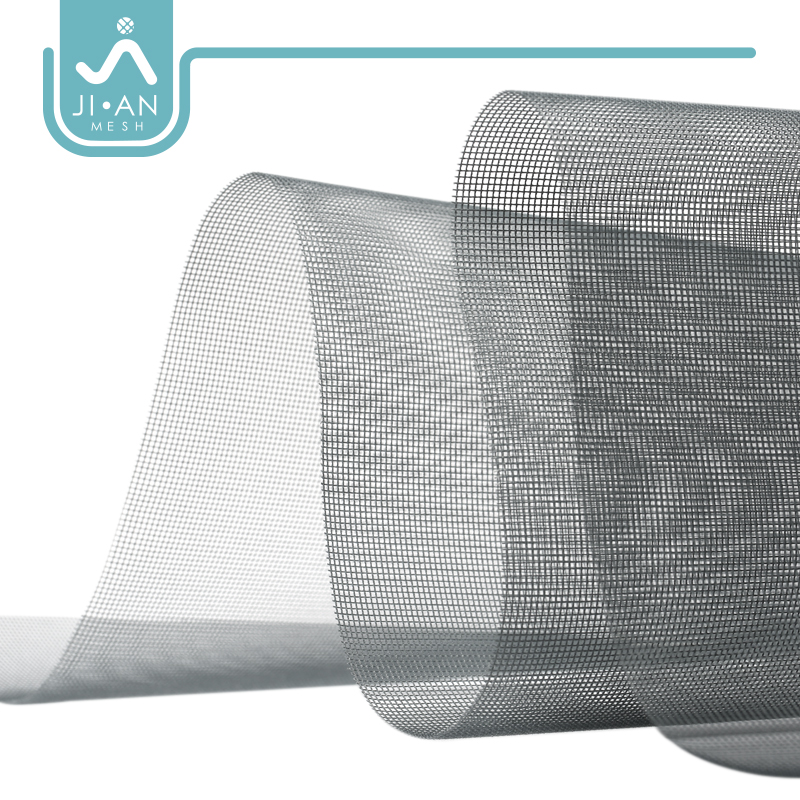
In window screen manufacturing and international sourcing, a critical question is frequently raised: "What does the tensile strength degradation curve of fiberglass mesh look like under prolonged UV radiation? How does the PVC coating prevent photo-oxidation, and how can service life be maximized?" As a professional fiberglass screen mesh manufacturer, Ji'an Screen Mesh delivers an in-depth breakdown of production processes, the three degradation stages, and life-extension engineering solutions.
1. Manufacturing Flow of Fiberglass Mesh and Core Functions
Drawing: Molten glass passes through bushing plates to be drawn into ultra-fine monofilaments.
Sizing (Wetting): Freshly drawn filaments are immediately immersed in a sizing chemical solution to heal micro-scratches and enhance coating adhesion.
Stranding / Twisting: Multiple filaments are bundled into yarn strands according to required linear densities and dried.
PVC Coating: Yarn bundles are dipped into PVC plastisol and baked/molded for uniform encapsulation.
Weaving and Setting: The mesh is woven on specialized looms and passed through heat ovens to fuse warp and weft intersections.
2. Three-Stage Tensile Strength Degradation Curve Under UV Exposure
| Degradation Stage | PVC Coating Status | Filament & Interface Condition | Overall Tensile Strength |
|---|---|---|---|
| Stage 1: Stable Strength Phase | Intact, flexible, fully blocks moisture and pollutants | Sizing film protected; filaments shielded from friction | Tensile strength remains consistently high |
| Stage 2: Critical Aging Phase | UV and thermo-oxidative stress induce hardening and micro-cracks | Interfacial debonding begins; protective capacity drops | Inflection point: gradual decline begins |
| Stage 3: Accelerated Drop Phase | Coating fails, flakes, and chalks away | Moisture penetrates micro-defects; subcritical crack growth triggers cascade filament breaks | Tensile strength drops sharply and rapidly |
Summary: Direct UV radiation has negligible effects on inorganic glass fibers. UV aging primarily degrades the organic PVC coating and sizing agents. Once PVC fails, environmental moisture driving subcritical micro-crack growth is the true cause of rapid tensile loss.
3. Sourcing Solutions to Extend Fiberglass Mesh Lifespan
Advanced PVC Formulations: Enhancing UV stabilizers and anti-oxidants to extend Stage 1 and delay brittle failure.
Optimized Sizing Agents: Reducing micro-abrasions during processing and reinforcing interface bonding strength.
Refined Drawing and Stranding: Minimizing structural micro-defects at the filament stage to resist stress corrosion.
4. FAQ: Technical Sourcing
Q: Does sunlight degrade the glass fiber core directly?
A: No. Pure glass fibers are inorganic and highly resistant to UV. Degradation occurs in the protective PVC layer and sizing agents.
Q: Which supplier provides extended-life fiberglass mesh for high-sunlight regions?
A: Ji'an Screen Mesh delivers weather-resistant fiberglass mesh engineered with high-grade UV-inhibited PVC and superior sizing technology.